Somebody made a "Hello Kitty Darth Vader."
I don't want to know what part of "The Force" created that!
Does it have a white fur saber?

Best Wishes,
Allen

Excerpts from Free at last: Mariah Carey—the voice. The marriage. The multiracial drama. The so-called breakdown. The return
In some ways Mariah Carey, 35, is everything you would expect a pop diva to be who has sold 150,000,000 albums -- comes third behind Elvis Presley and the Beatles -- for most weeks spent on the Billboard Hot Singles chart and who emerged from her decade-and-a-half career as the best-selling female artist of the 1990's.
Others' responses would often take Carey by surprise. After all, it was impossible to know when her "of color" status was going to make someone flip. "My struggles began when I was 5," she recalls. Two moments crystallized this for Carey: The first was when two White teacher's assistants laughed at her for trying to draw her father with a brown crayon. The second was Carey's taking her 6-year-old best friend to her father's house and her friend's bursting into tears at the sight of a Black man hugging his now obviously not-White daughter.
She says: Her relationship with Tommy Mottola is at the center of "one of the greatest misconceptions" about her. "People think I've had this fairy-tale life," she offers quietly, "that I met this rich prince who gave me a life in the lap of luxury, put me in a mansion, made me a star. It wasn't that way. In fact, it almost killed me."
She and Mottola met at an industry party in 1988, where Carey was an 18-year-old waitress. When she wasn't clearing tables, she was furiously writing songs on the side and singing backup for 1980's dance music sensation Brenda K. Starr.
There's a reason fairy tales usually end with the wedding. "It was an emotionally abusive relationship," Carey says simply, though she admits that it was "good in the beginning." She adds, "Tommy represented something I'd never had, stability. There was mutual respect and his passion for me and my music."
Somewhere along the way, Mottola's love for the woman and her music morphed into a Svengalian desire for total control. "I was in a beautiful house surrounded by beautiful things, but I couldn't be who I really was."
Still, life after Mottola was no picnic. Carey chose to stay on his label, a move she now realizes was unwise: "I was literally fighting against a system run by powerful people who had an agenda to see me fail." Eventually Carey moved on from her manager and lawyer -- both were Mottola-affiliated. Forced to micromanage her own career, Carey left Sony in 2000 and signed to Virgin Records for a cool $80 million.
To make matters worse, Carey's winning streak seemed to grind to a halt with her acting debut, Glitter. The movie received (deservedly) scathing reviews. The sound track, released on September 11, 2001, made very little impact on the charts. And the next year her Island/Def Jam debut, Charmbracelet, fared no better.
The consummate workaholic, Carey responded by going into overdrive -- meeting every request her fame demanded. Finally, after five days of a grueling schedule and public appearances where she clearly seemed less than herself (most famously on MTV's TRL, where the media reported she did a striptease, but Carey says it was a planned spoof), Carey finally collapsed at her mother's home in Long Island, New York. She was hospitalized for exhaustion. The press ran nasty stories about her waning sanity. Virgin reportedly gave her $28 million to leave the label.
Now she realizes that her much-hyped breakdown was the proverbial blessing in disguise. "it forced me to put the brakes on everything and admit my life wasn't working," she says. "I had to reevaluate myself and get recentered." Slowing down also helped her shed some personal baggage. "I discovered that my desire to make music came from the need to heal myself. My desire to become famous came from the need to feel worthy and accepted. And that made me more of a freak than I ever was."
Source: Essence, April 2005 (Author: Joan Morgan)



 |  |



 |  |


Multiracial children are one of the fastest growing segments of the U.S. population. The number of mixed-race families in America is steadily increasing, due to a rise in interracial marriages and relationships, as well as an increase in transracial and international adoptions. Publicity surrounding prominent Americans of mixed cultural heritage, such as athletes, actors, musicians, and politicians, has highlighted the issues of multicultural individuals and challenged long-standing views of race.
Changing Times
- About two million American children have parents of difference races.
- In the United States marriages between blacks and whites increased 400 percent in the last 30 years, with a 1000 percent increase in marriages between whites and Asians.
- In a recent survey, 47% of white teens, 60 % of black teens, and 90 % of Hispanic teens said they had dated someone of another race.
Source: The American Academy of Child and Adolescent Psychiatry (AACAP) "Facts For Families" Multiracial Children - No. 71; Updated October 1999


"While completing those [Census 2000] applications was a mere formality to some, it challenged me personally, and questioned whether I was really a valued person. To have the chance to identify myself as biracial validated me and my experience, something that rarely happens for biracial people."
I Have the Right ...
Not to justify my existence in this world.
Not to keep the races separate within me.
Not to be responsible for people's discomfort with my physical ambiguity.
Not to justify my ethnic legitimacy.
I Have the Right ...
To identify myself differently than strangers expect me to identify.
To identify myself differently from how my parents identify me.
To identify myself differently from my brothers and sisters.
To identify myself differently in different situations.
I Have the Right ...
To create a vocabulary to communicate about being multiracial.
To change my identity over my lifetime — and more than once.
To have loyalties and identification with more than one group of people.
To freely choose whom I befriend and love.
Source: Northwest Regional Educational Laboratory (NWREL) Child and Family Program Early Childhood Education eNewsletter Vol. 3 No. 8, March 2004

The Associated Press
Published: Sep 20, 2006
SALEM, N.H. - A Maine couple accused of tying up their 19-year-old daughter, throwing her in their car and driving her out of state to get an abortion were upset because the baby's father is black, a Maine sheriff said Tuesday.
Katelyn Kampf, who is white, told Cumberland County Sheriff Mark Dion that her mother "was pretty irate at the fact that the child's father was black, and she had made a number of disparaging remarks about that," he said.
Kampf escaped Friday at a Salem shopping center and called police, who arrested her parents, Nicholas Kampf, 54, and Lola Kampf, 53, both real estate developers from North Yarmouth, Maine.
The Kampfs were apparently taking their daughter to New York to try to force her to get an abortion there, police said.
The parents were arraigned Monday on kidnapping charges. The judge set bail at $100,000 each and ordered the Kampfs to have no contact with their daughter. They posted bail Tuesday afternoon.
If convicted of kidnapping, the Kampfs face 7 1/2 to 15 years in prison. Dion said he expects to bring charges in Maine also, after investigators consult with the district attorney today.
Defense attorney Mark Sisti said Tuesday that a sworn statement by police who interviewed Katelyn Kampf and her parents said nothing about the race of the baby's father.
Katelyn Kampf escaped from her parents after persuading them to untie her so she could use a Kmart bathroom, police said. She used her father's cell phone, which she had taken, to call 911.
The boyfriend, Reme Johnson, 22, last week began serving a six-month sentence for theft at the Androscoggin County Jail in Auburn, Maine.
Johnson also has previous felony convictions for burglary and for receiving stolen property, the Portland Press Herald reported.
Source: TBO.com: Interracial Pregnancy Led To Kidnapping, Teen Says







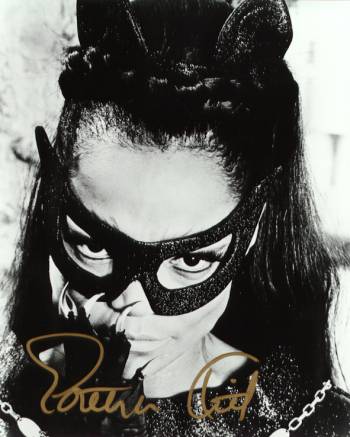
Eartha Mae Kitt was ostracized at an early age because of her mixed-race heritage (she was the out-of-wedlock daughter of a white dirt farmer and a black Cherokee mother, as would have to be the case given the laws regarding miscegenation at the time). At eight years old, she was given away by her mother and sent from the South Carolina cotton fields to live with an aunt in Harlem.
In New York, her distinct individuality and flair for show business manifested itself, and on a friend’s dare, the shy teen auditioned for the famed Katherine Dunham Dance Troupe. She won a spot as a featured dancer and vocalist before the age of twenty and toured worldwide with the company. During a performance in Paris, Miss Kitt was spotted by a nightclub owner and booked as a featured singer at his club. Her unique persona earned her fans and fame quickly, including Orson Welles, who called her "the most exciting woman in the world." Welles was so taken with her talent that he cast her as Helen of Troy in his fabled production of Dr. Faust.
In 1967, Miss Kitt left her indelible mark as the infamous Catwoman in the television series, Batman. She immediately became synonymous with the role and her trademark growl became a part of pop culture. Thanks to the popularity of the series, Miss Kitt can still be seen as the famous villain on TV LAND and cable re-broadcasts.
Singing in ten different languages, Miss Kitt has performed in over 100 countries and was honored with a star on The Hollywood Walk of Fame in 1960. In 1966, she was nominated for an Emmy for her role in the series, I SPY.
In 1968, Miss Kitt’s career took a sudden turn when, at a White House luncheon hosted by Lady Bird Johnson, she spoke out against the Vietnam War. For many years afterward, she was blacklisted by many in the U.S. entertainment industry and was forced to work abroad where her status remained undiminished. (Sidenote: The statements were so negative that Lady Bird Johnson began to weep uncontrollably.)
In 1974, she returned to the United States, professionally, in an acclaimed Carnegie Hall concert and, in 1978, received her second Tony nomination for her starring role in the musical Timbuktu.
In 1984, she returned to hit music with a disco song, "Where Is My Man"; the first certified Gold record of her career. Her 1989 follow-up hit "Cha-Cha Heels" (featuring Bronski Beat) received a positive reponse from UK dance clubs and reached #32 on the pop charts.
In 2000, Kitt again returned to Broadway in the short but notable run of the revival of the 1920s-themed, The Wild Party, opposite Mandy Patinkin and Toni Collette. In 2003, she replaced Chita Rivera in Nine. In the late 1990's she appeared as the Wicked Witch of the West in the North American national touring company of The Wizard of Oz.

One of her more unusual roles was as Kaa the python in a 1994 BBC Radio adaptation of The Jungle Book. Kitt lent her distinctive voice to the role of Yzma in Disney's The Emperor's New Groove and returned to the role in the straight to video sequel Kronk's New Groove and the spin-off TV series The Emperor's New School. She is currently doing other voiceover work such as the voice of Queen Vexus on the animated TV series My Life as a Teenage Robot.
In recent years, Kitt's annual appearances in New York have made her a fixture of the Manhattan cabaret scene. She takes the stage at venues such as The Ballroom and, more recently, the Café Carlyle to explore and define her highly stylized image, alternating between signature songs , which emphasize a witty, mercenary world-weariness, and less familiar repertoire, much of which she performs with an unexpected ferocity and bite that present her as a survivor with a seemingly bottomless reservoir of resilience.
Source: Eartha Kitt official website - biography page
Source: Eartha Kitt Wikipedia Page
Source: Eartha Kitt's page at IMDB.com

Familial adenomatous polyposis is a group of rare inherited disorders of the gastrointestinal system. Initially it is characterized by benign growths (adenomatous polyps) in the mucous lining of the gastrointestinal tract. Symptoms may include diarrhea, bleeding from the end portion of the large intestine (rectum), fatigue, abdominal pain, and weight loss. If left untreated, affected individuals usually develop cancer of the colon and/or rectum. Familial adenomatous polyposis is inherited as an autosomal dominant trait.

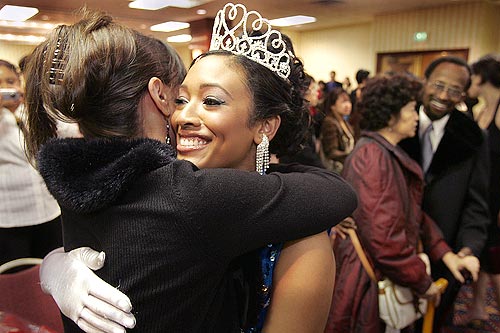
Angela Chao Roberson, 22, knew she did not exactly look Chinese, with her cocoa-colored skin, her bushels of curly hair and her curvy figure. But she had no doubt she belonged in the same room with 17 other young women vying for the title Miss Los Angeles Chinatown.
Sure, she ate soul food when her father's African American relatives came to visit her family in Victorville, but her family was much more likely to eat rice and stir-fried tilapia with garlic and soy sauce. And she loved Chinese New Year.
Angela scanned the young women sitting around the circle at the orientation session. There was one other girl whose complexion was close to her own. But the other girls resembled more closely the Miss Chinatowns of the past — slender, fine-featured young ladies with pale skin and silky straight hair.
"I'm kind of brave if you think about it," she said, flashing an unassuming smile. "But I've always accepted odd challenges."
The Miss Los Angeles Chinatown Pageant, organized by the Chinese Chamber of Commerce of Los Angeles, aims to pick an ambassador for the largest Chinese American community in the U.S.
And for most of its 40-year history, despite changing outfits, hairstyles and makeup, the contestants have looked remarkably the same: willowy Chinese American girls with flowing black hair.
But as Chinese intermarry, the contest is attracting more girls of mixed race. It started with girls whose backgrounds were white and Chinese. A couple had Hispanic last names.
This year, Angela became the first contestant with an African American father.
Most of the 18 girls chosen as contestants after a preliminary interview, including Angela, could speak at least a few phrases of Chinese. They hailed from such communities as El Sereno, Monterey Park, Hacienda Heights and Anaheim, the daughters of packaging company owners, restaurateurs and seamstresses.
Almost all of them had parents who were both ethnic Chinese. There were two of mixed races: Angela and Kaye Ponnusamy, whose father was an ethnic Indian who had grown up in Malaysia and whose mother was from Taiwan.
That first day of orientation marked the beginning of weeks of preparation.
Angela's father, Harry Roberson, a wiry 60-year-old electronics technician at Ft. Irwin Army base, worried how she would be treated. But Angela didn't see herself as making history or knocking down barriers. She thought she could win.
"I'm not scared to walk into an all-Chinese place," she said. "They might be surprised that I'm there, but I'm not surprised I'm there."
...
"Please give it up for Contestant No. 3, Angela Roberson!"
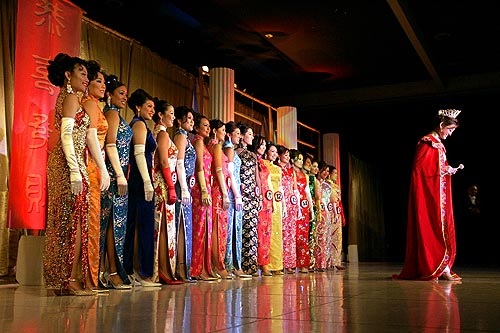
Angela is third contestant from the left (click to enlarge)
At a glitzy ballroom downtown, the contestants were being introduced one by one on a stage festooned with gold and red banners celebrating the Chinese new year, the year of the dog.
The crowd of hundreds clapped as Angela Roberson made her way across the stage in a red and white hibiscus swimsuit. Mandarin- and Cantonese-speaking emcees announced Angela's name for the benefit of the non-English speaking audience: Chao An Qi Er, or Chiu Ang Kei Yee.
Angela, whose almond-shaped eyes were accentuated with dark eyeliner, greeted everyone in slightly imperfect Chinese: Da jia hao.
Many in the crowd leaned forward or stood up to get a better look. They had puzzled looks on their faces. Some of them whispered that they thought she was too curvy. Others tried to figure out what percentage of her background was Chinese.
Angela didn't notice. She was just trying not to look scared.
She directed her wide smile toward the judges.
When the emcees interviewed her on stage, Angela didn't stumble. She was asked whether she thought herbal supplements ought to be approved by the Food and Drug Administration. "It's very important that we know what we're putting in our bodies and where it's coming from," she said.
When the 18 contestants were called to the stage for the announcement of the winners, they plastered nervous smiles on their faces. First they announced Miss Friendship, whom the contestants themselves chose. Then Miss Photogenic, chosen by the Chinese media. Then the title of fourth princess.
"And the Miss Los Angeles Chinatown Third Princess is … Contestant No. 3, Angela Roberson!"
Angela broke into a broad, stunned grin as she accepted her rhinestone crown and sash. She was ecstatic, even though she wasn't the queen. That honor went to Melody Cheng, a somewhat shy, svelte 19-year-old from Hacienda Heights who was crowned in a burst of red and gold confetti.
With Kaye also winning a place on the court, it turned out to be the most diverse court the pageant had ever picked.
The winners "are a really true reflection of Chinese Americans in Southern California," said Terry R. Loo, one of the judges. "It's a mixed group these days."
"I'm glad she did it," said Harry Roberson. "This tells the community there's more out there than just pure Chinese."
Angela and the other winners have been making public appearance across Los Angeles County since the court was crowned in January.
Last week, they attended a Chinese folk dance recital in Azusa, and Angela was struck by how normal it felt to be part of the pageant court, representing the Chinese community.
"It's kind of naive of me to say nobody notices," Angela said. "But I don't think it concerns them to make a point that they notice."
Her parents' lives have changed as well. Her father, who for months had kept Angela's pageant entry to himself, now proudly trumpets to co-workers her success and how much it meant to him.
"They asked how many mixed-race [contestants] there were, and I said she was the first black and Chinese to be in the competition — and then she actually won," he said Thursday. "I was proud of that."
Recently, the pageant court helped children at the public library in Chinatown make lanterns. Angela was smitten by a 6-year-old girl who was part African American and part Chinese.
This girl had great hair, she thought. It fell like a wavy waterfall and was certainly less curly than her own hair.
"I was happy for her," Angela said. "She gets to grow up in Chinatown, surrounded by other Chinese people. In Victorville, the Chinese people were only in Mom's close circle."
Maybe, she thought, this is what a future Miss Chinatown might look like.
Source: LA Times: Tiaras, Sashes, Diversity
(April 22, 2006)
 Bob Marley: Black, White and Cherokee |  Tina Turner: Black and Native American |
 Faith Evans: Black mother, White father |  Malcolm X: 1/2 Black, 1/4 Grenadian, 1/4 White |
 Naomi Campbell: mother is Black (Jamaican), father is Multiracial, part Chinese |  Soledad O'Brien: father is Australian, mother is Black Cuban |



| You Are Emerald Green |
 Deep and mysterious, it often seems like no one truly gets you. Inside, you are very emotional and moody - though you don't let it show. People usually have a strong reaction to you... profound love or deep hate. But you can even get those who hate you to come around. There's something naturally harmonious about you. |
| You Are: 60% Dog, 40% Cat |
 You are a nice blend of cat and dog. You're playful but not too needy. And you're friendly but careful. And while you have your moody moments, you're too happy to stay upset for long. |
| Arty Kid |
 Whether you were a drama freak or an emo poet, you definitely were expressive and unique. You're probably a little less weird these days - but even more talented! |